Heating of Industrial Halls
Heating industrial halls represents a significant operating cost for every manufacturing or logistics company. High ceilings, large volumes of air and frequent opening of doors lead to considerable heat losses that conventional warm-air systems often cannot handle efficiently. Radiant heating for industrial halls transfers heat directly into the working zones, increasing energy efficiency and reducing long-term operating costs.
In this section you will find real case studies of industrial buildings where we designed and implemented energy-efficient radiant heating solutions. Each study presents the specific challenge, the selected system, the achieved results and the energy savings – giving you a clear idea of how efficient radiant heating can work in your facility as well.
Read about our solutions from selected industrial hall heating projects:
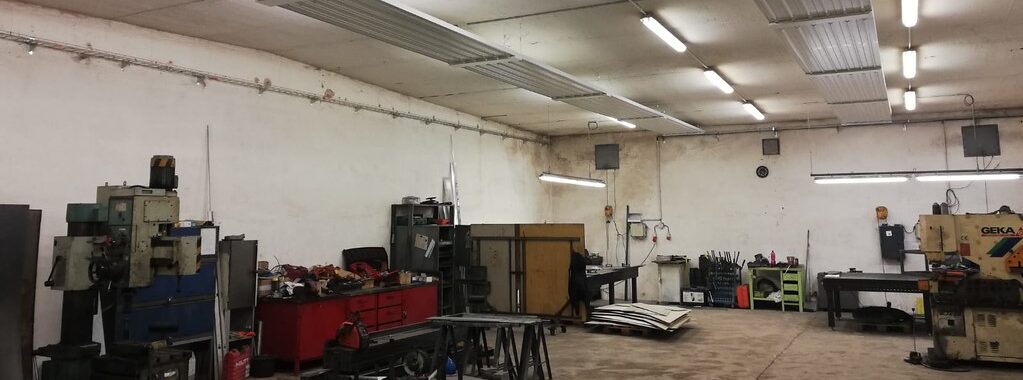
Case Study – Radiant Heating Installation in a Locksmith Workshop with Fully Utilized Walls
The family business was founded in 1992 and has been engaged in locksmithing and artistic blacksmithing from the very beginning. With the introduction of modern machinery, the company gradually expanded its activities to include supplying complete units for construction companies, manufacturing steel structures and construction locksmithing elements according to technical specifications, as well as producing thin sheet metal products and other locksmithing components.
Today, the company focuses on two main areas of activity: the manufacture of thin sheet metal products and the production of construction locksmithing elements.
Important customers include LINET s.r.o., TOORS CZ s.r.o., Autosystem Climatronic, and in the construction sector the company cooperates with contractors such as BAK a.s., Metrostav a.s., Průmstav-FCC a.s., and others.
|
Type of building: |
Locksmith workshop |
|
Original heating method: |
Unheated space |
|
Heat source: |
Heat pump / electric boiler |
|
Installed radiant panel output: |
10 kW (52/45/15 °C) |
|
Heated area: |
200 m2 / 740 m3 (height 3,7 m) |
|
Year of installation: |
January 2021 |
Investor’s requirements
Economical heating of a small existing locksmith workshop using a low-temperature heat source, i.e. a heat pump, which the investor plans to install in the future. For the time being, the heat source is a small electric boiler operating at a maximum temperature of 45–50 °C.
An important requirement from the investor was to keep the walls free. In a workshop environment the walls are fully utilized, which makes the installation of conventional radiators impractical.
Solution
Based on a request from the heating contractor, we prepared two design options. The customer selected a solution consisting of two 18-m-long hot-water radiant panels of the Kotrbatý KSP to go system with a width of 900 mm, designed to operate with a heat pump as a low-temperature heat source.
Customer review
Based on the positive experience, the customer decided to gradually use radiant heating in other halls, where they still use hot air heating. The first winter successfully tested the system even during very long frosts, when outside temperatures ranged down to -12°C and the workshop was still comfortable and at the desired temperature. The heating water temperature was set to 45°C, even in extreme frosts. “Overall, the workers highly praise the radiant heating, and therefore we would like to gradually convert the remaining workshops to radiant heating.”

30% energy savings
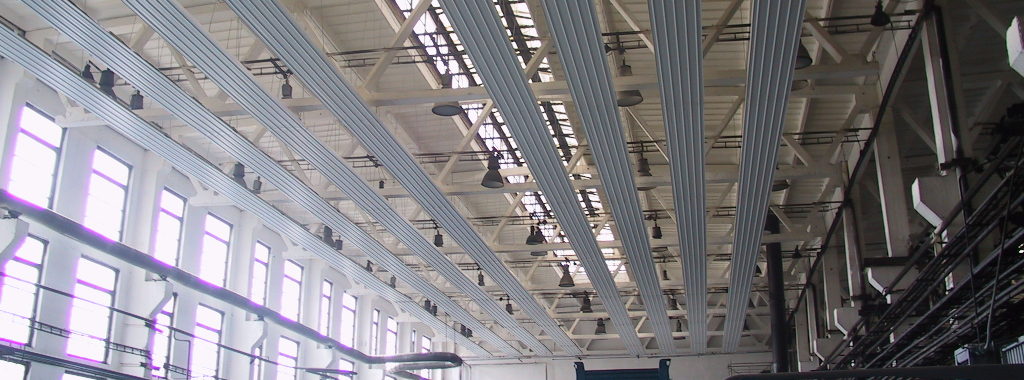
Case Study – Reduction of Heating Costs in an Industrial Complex
The heating project for the large ZSNP industrial complex in Žiar nad Hronom is one of the most comprehensive installations using ceiling radiant heating in the Czech Republic and Slovakia. The assignment from the investor – the PENTA Group – was to minimize heat losses in the extensive heat distribution network while making the most efficient use of a combined heat and power source.
The original hot-water warm-air heating system proved to be inefficient in such a large industrial complex. The solution therefore consisted of replacing this system with a network of radiant panels designed as part of the overall energy concept of the site. The project was implemented in 2008. By replacing the warm-air heating system with radiant panels, heat consumption was reduced by more than 32%. The successful results led to further expansion of the system into other parts of the complex in the following years.
Today, approximately 6,000 m² of radiant panels are installed throughout the complex, with a total length of nearly 10 km, and the total heating capacity of the system reaches 7.8 MW. The optimization of heat supply costs was one of the factors that contributed to attracting foreign investors such as SAPA Group, Nemak, Fagor, Foundry and Dalkia.
|
Type of facility: |
Industrial complex |
|
Original heating system: |
Warm-air heating |
|
Heat source: |
Combined heat and power (CHP) plant |
|
Installed radiant panel output: |
7,8 MW (140 / 70 °C) |
|
Installed radiant panel area: |
6,000 m² / approx. 10 km |
|
Year of installation: |
Since 2008 |
Investor’s Requirements – Heating System Reconstruction
The investor – the PENTA Group – required a solution that would minimize heat losses in the extensive heat distribution network while making the most efficient use of a combined heat and power source.
Solution
The solution consisted of replacing the warm-air heating system with a network of KSP radiant panels designed as part of the overall energy concept of the industrial complex. The result was a reduction in heat consumption of more than 32%.
The investor’s satisfaction led to further expansion of the system, and today more than 10 km of radiant panels have been installed across the entire complex.
Kotrbatý Company Evaluation
This project represents the most comprehensive solution for heat supply in an industrial complex in the Czech Republic and Slovakia using radiant panels.
The entire complex is supplied from a reconstructed combined heat and power source with a nominal temperature regime of 140 / 70 °C. The design addressed several key aspects, including the characteristics of the heat source (with a requirement for the lowest possible return temperature), the extensive heat distribution network (minimizing pipeline heat losses), and the capabilities of the heating system based on radiant panels.
By designing the system as a complete integrated solution, it was possible to significantly optimize the cost of heat supply. Together with other factors, this ultimately attracted several foreign investors who gradually purchased facilities in the complex from the original investor (SAPA Group, Nemak a.s., Fagor, Foundry, Dalkia, etc.).
Over the following years, the installed capacity was gradually increased to the current level of nearly 8 MW. Control of individual heating zones is provided by control blocks with ejectors and controllers equipped with an optimization program from the German company Baelz.
Ing. Martin Kotrbatý
32% reduction in heat consumption
Operational Reality
Heating industrial halls must always be evaluated not only in terms of installed capacity but also according to the actual operation of the building. Key factors include the height of the space, ventilation intensity, frequency of door openings and the required temperature in the working zone.
In high industrial halls, the temperature difference between the floor level and the ceiling can reach several degrees. With convective heating systems, this often results in significant energy losses. Modern radiant heating systems reduce this effect and allow stable thermal comfort to be achieved with lower energy consumption.
For this reason, a properly designed heating system for an industrial hall is essential for long-term reduction of operating costs.